
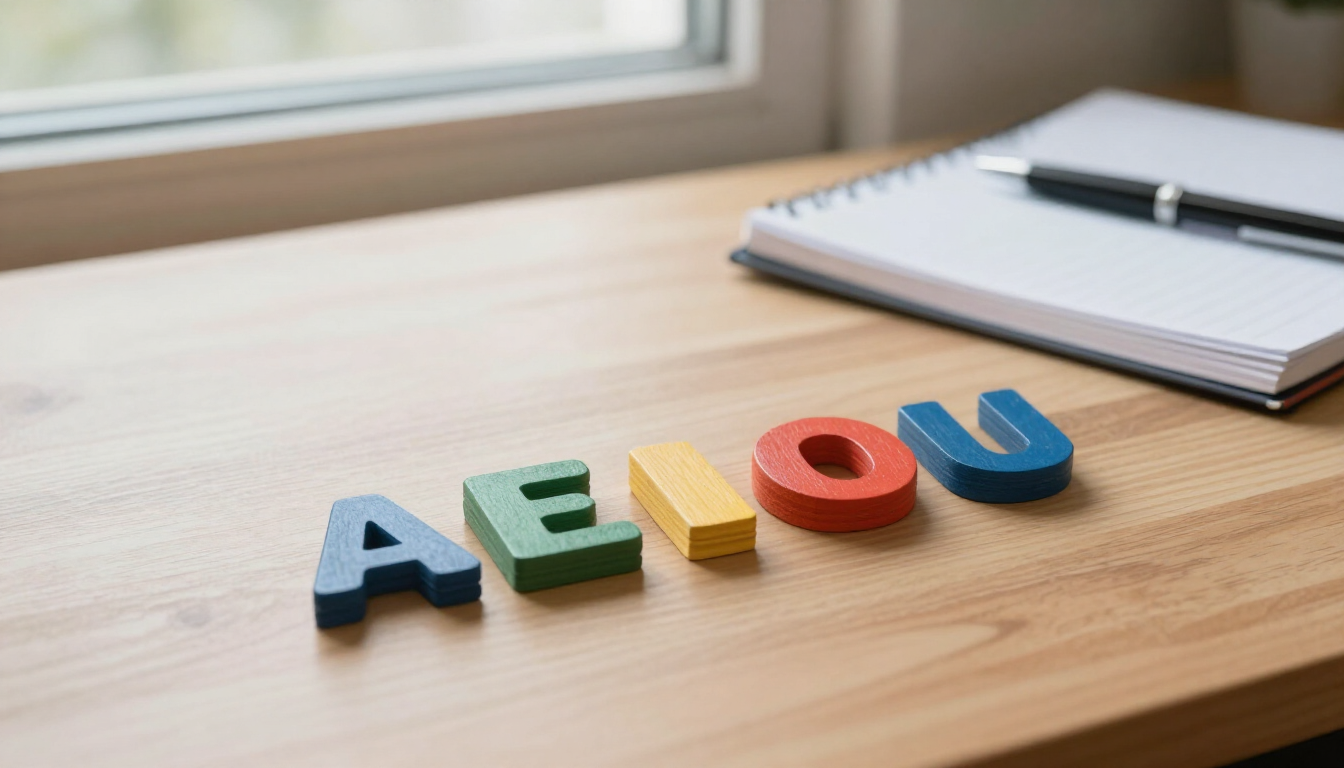
How Do You Count Vowels? The Complete Guide
A complete walkthrough of counting vowels in text — manual methods, short and long vowel sounds, and code examples in Python, Java, and C for counting vowels and consonants.
EveryTextTool Editorial
To count vowels, go through each character in a word or sentence and increase a counter whenever you find a, e, i, o, or u — usually after converting the text to lowercase. In programming, spaces, punctuation, and digits are normally ignored; whether y counts depends on the rule you choose. This guide walks through the concept, the short and long vowel sounds, and practical code examples you can run with our vowel counter.
Counting Vowels in a String
How to count vowels in Java?
In Java, convert the string to lowercase, loop through each character, and increment a counter when the character is one of a, e, i, o, or u.
String text = "Hello World";
int vowels = 0;

for (char c : text.toLowerCase().toCharArray()) {
    if ("aeiou".indexOf(c) != -1) {
        vowels++;
    }
}

System.out.println(vowels); // 3
"Hello World" contains three vowel letters: e, o, and o.
How to count vowels in a string?
Counting vowels in a string means counting occurrences of the vowel letters, not necessarily distinct vowels. For example, "banana" has three a letters, so it contains three vowels.
If you need the count for each vowel separately, use separate counters for a, e, i, o, and u — exactly what the vowel counter breakdown shows.
How to count vowels in a string Python?
In Python, use a loop or a generator expression with sum(). The simplest approach is:
text = "Hello World"
vowels = "aeiou"

count = sum(1 for char in text.lower() if char in vowels)
print(count)  # 3
This counts each occurrence of a, e, i, o, and u, ignoring case.
How to count vowels in a string Java?
The Java approach is the same as above: normalise case, inspect each character, and increment a counter for a vowel match. A HashSet can also store the vowels and make membership checks clear.
Set<Character> vowels = Set.of('a', 'e', 'i', 'o', 'u');
int count = 0;

for (char c : text.toLowerCase().toCharArray()) {
    if (vowels.contains(c)) {
        count++;
    }
}
Length & Duration: Short vs Long Vowels
| Concept | Short vowel | Long vowel |
|---|---|---|
| Sound | Usually a quick, clipped sound | Often "says its name" or lasts longer |
| Example | cat, bed, sit, hot, cup | cake, see, bike, hope, cute |
| Common clue | Often followed by a consonant | Often appears in an open syllable or with a silent e |
| Teaching order | Usually taught first | Usually introduced after short vowels |
How many short vowels do we have?
English has five short vowel sounds commonly taught in early phonics: short a, e, i, o, and u, as in cat, bed, sit, hot, and cup.
How to identify long vowels and short vowels?
A long vowel often "says its own name," such as the long a in cake or long o in hope; a short vowel does not, such as the short a in cat or short o in hot.
Look for patterns such as a silent e (hope, cute) or vowel teams (rain, team), but English has many exceptions, so pronunciation and word patterns matter more than a single rule.
Do you teach short or long vowels first?
Most phonics programmes teach short vowels first, because they appear frequently in simple CVC words such as cat, dog, and sun. Long vowels are generally introduced once learners can decode basic short-vowel words.
What makes a vowel short or long?
The difference is the sound, not the letter itself. A vowel is short when it makes a clipped sound, and long when it makes a lengthened sound or "says its name"; spelling patterns, silent e, and vowel teams often provide clues.
Counting Vowels in Python
How do you count vowels in Python?
Use str.lower() and check membership in the vowel set:
def count_vowels(text):
    return sum(1 for char in text.lower() if char in "aeiou")

print(count_vowels("Programming is fun"))  # 6
This counts every occurrence, not just unique vowel letters.
How to count vowels and consonants in Python?
Treat a, e, i, o, and u as vowels; treat every other alphabetic character as a consonant; ignore spaces, digits, and punctuation. You can verify your counts with both the vowel counter and the consonant counter.
def count_vowels_and_consonants(text):
    vowels = consonants = 0

    for char in text.lower():
        if char in "aeiou":
            vowels += 1
        elif char.isalpha():
            consonants += 1

    return vowels, consonants

print(count_vowels_and_consonants("Hello World"))  # (3, 7)
"Hello World" has 3 vowels and 7 consonants when y is not counted as a vowel.
How to count vowels in a sentence Python?
Use the same method on the whole sentence. Spaces and punctuation are naturally excluded if you only count characters found in "aeiou".
sentence = "The quick brown fox jumps."
vowels = sum(char in "aeiou" for char in sentence.lower())
print(vowels)  # 6
How to count vowels in a word?
For a single word, apply the same character-by-character check. For "education", the vowel letters are e, u, a, i, and o, giving a count of 5.
Counting Vowels and Consonants
How to count vowels and consonants in Java?
Convert the text to lowercase, then use one branch for vowels and another for alphabetic characters that are not vowels. Digits, spaces, and punctuation should not be counted as consonants.
int vowels = 0;
int consonants = 0;

for (char c : text.toLowerCase().toCharArray()) {
    if ("aeiou".indexOf(c) != -1) {
        vowels++;
    } else if (c >= 'a' && c <= 'z') {
        consonants++;
    }
}
How to count vowels and consonants in C?
In C, loop through the string with strlen() or until the null terminator, compare each character with the vowels, and count remaining alphabetic characters as consonants.
#include <ctype.h>
#include <string.h>

int vowels = 0, consonants = 0;

for (size_t i = 0; i < strlen(text); i++) {
    char c = tolower((unsigned char) text[i]);

    if (strchr("aeiou", c)) {
        vowels++;
    } else if (isalpha((unsigned char) text[i])) {
        consonants++;
    }
}
The key rule is to count only alphabetic characters as consonants; otherwise spaces and punctuation will be misclassified.
How to count vowels and consonants?
Count vowels as occurrences of a, e, i, o, and u; count consonants as all other alphabetic letters. For "Hello World", the result is 3 vowels and 7 consonants.
About Vowels
How to count vowels?
Manually, underline every a, e, i, o, and u, then add up the marks. Programmatically, initialise a counter to zero, inspect every character, and increment it on a vowel match. The vowel counter does this instantly.
Is y counted as a vowel?
It depends on context. In most beginner programming exercises, y is not counted as a vowel; in English phonics, y can function as a vowel, as in shy or baby, but as a consonant at the start of a syllable, as in yellow.
If your assignment does not specify, state your assumption: "I counted y as a consonant" or "I counted y as a vowel."
How to count vowel sounds?
Vowel sounds are not the same as vowel letters. English has more vowel sounds than vowel letters because combinations such as ea, oo, ai, and ou can represent different sounds; for example, rain, meet, and boat each contain vowel teams rather than single vowel letters.
Frequently Asked Questions
How do you count vowels in Python?
Use sum(1 for char in text.lower() if char in "aeiou"). This is concise, case-insensitive, and ignores characters that are not vowels.
How to count vowels?
Identify the five standard vowel letters — a, e, i, o, and u — then count every occurrence in the text. Decide beforehand whether y should be included.
How to count vowels in Java?
Loop over the lowercased string and increment a counter whenever the character is a, e, i, o, or u.
How many short vowels do we have?
There are five commonly taught short vowel sounds: a, e, i, o, and u.
How to count vowels in a string?
Iterate through the string and count matches for a, e, i, o, and u; convert to lowercase first so A and a are treated the same.
How to count vowels and consonants in Java?
Count a, e, i, o, and u as vowels, count other a–z characters as consonants, and skip non-letters.
Keep reading

How to Use a Word Counter to Improve Your Writing
A word counter is more than a number — it is a tool that helps you write tighter, clearer, and more effective content. Here is how to use it well.

Understanding Keyword Density for Better SEO
Keyword density used to be the holy grail of SEO. Today it is a balancing act. Learn what healthy density looks like and how to avoid over-optimization.